
Case Study
Defect detection in a 7‑pin power connector

Darius Rückert
- last updated on Jul 3, 2025
Read the paper on NDT.net
In collaboration with Robert Bosch GmbH Corporate Research, Renningen
Defect detection in multi‑material parts such as power connectors is frequently hindered by strong artefacts originating from dense metal structures that sit directly next to low‑density plastics. This case study explores how the Voxray Quantum Reconstruction Technique (QRT) improves industrial CT imaging when compared with standard Filtered Back Projection (FBP) and Dual‑Energy fusion (DE). We focus on typical defects – particles, voids, and gaps – and validate the CT results against a polished cross‑section examined by light microscopy (PST).

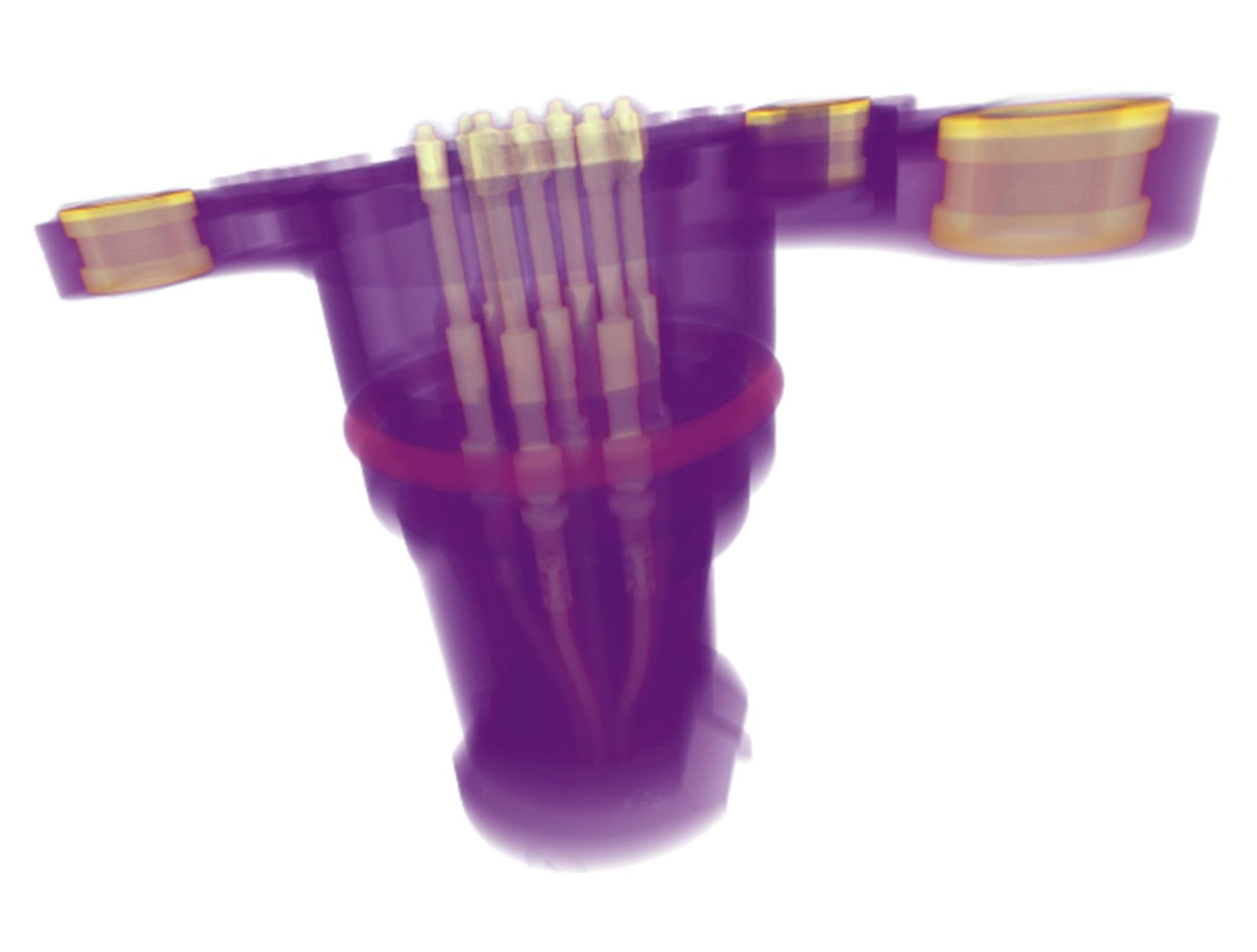
Photo of the 7‑pin power connector (left) and 3‑D volume rendering of the CT reconstruction (right).
Industrial CT of multi‑material assemblies suffers from artefacts that arise because traditional reconstruction does not fully account for the polychromatic X‑ray spectrum. Beam hardening, metal streaks and partial‑volume blurring are especially pronounced where copper alloy pins and polymer housings meet – exactly the regions that must be inspected for hidden defects.
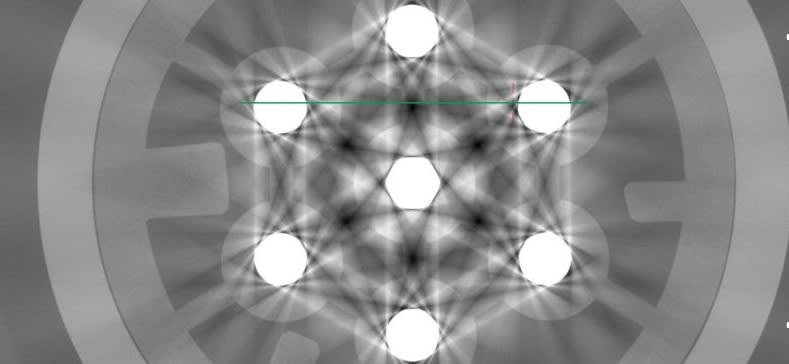
Horizontal slice reconstructed with standard FBP. Severe metal artefacts obscure the surrounding plastic, making analysis nearly impossible.
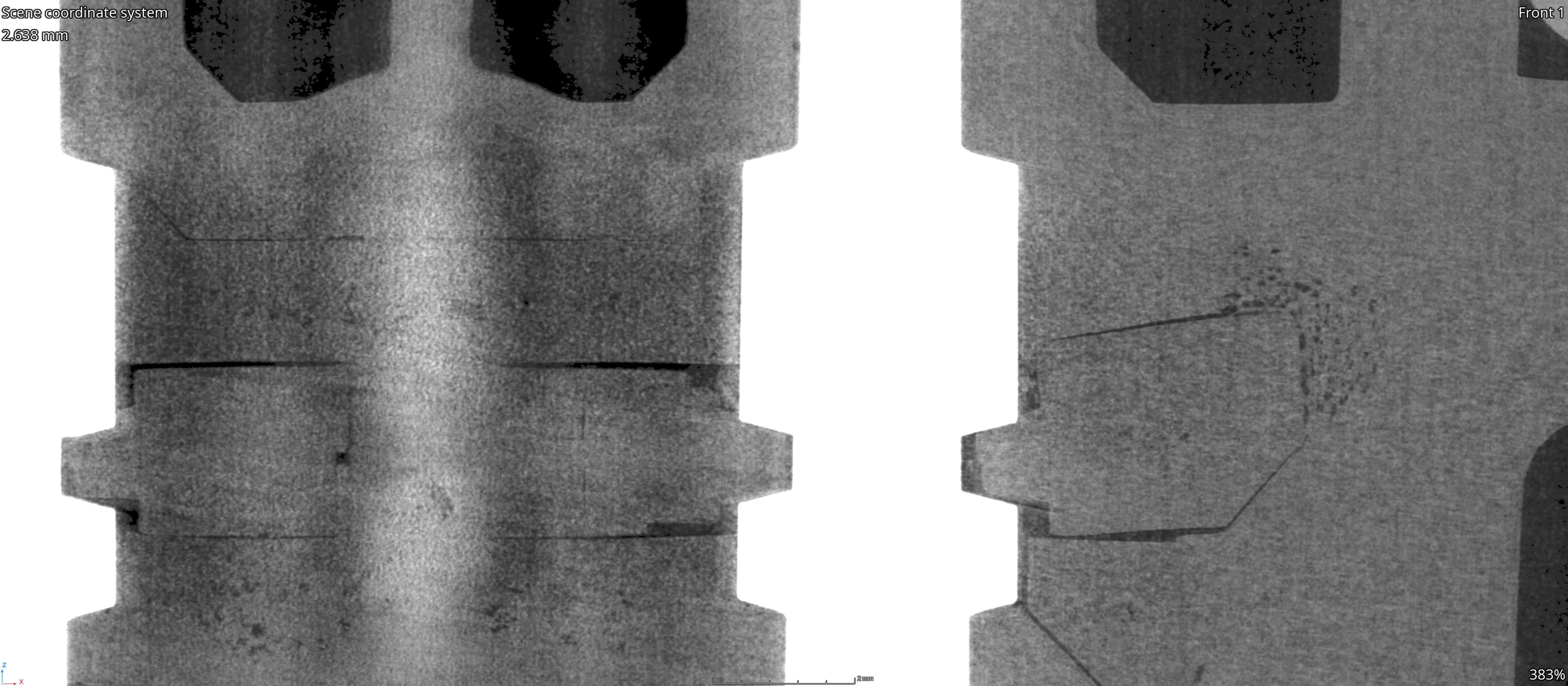
We reconstructed the connector using all three approaches and compared the resulting volumes to the reference micro‑section. Figure 4 highlights a region between two metal pins where voids, gaps and a plastic particle are present.
Slice‑by‑Slice Evaluation
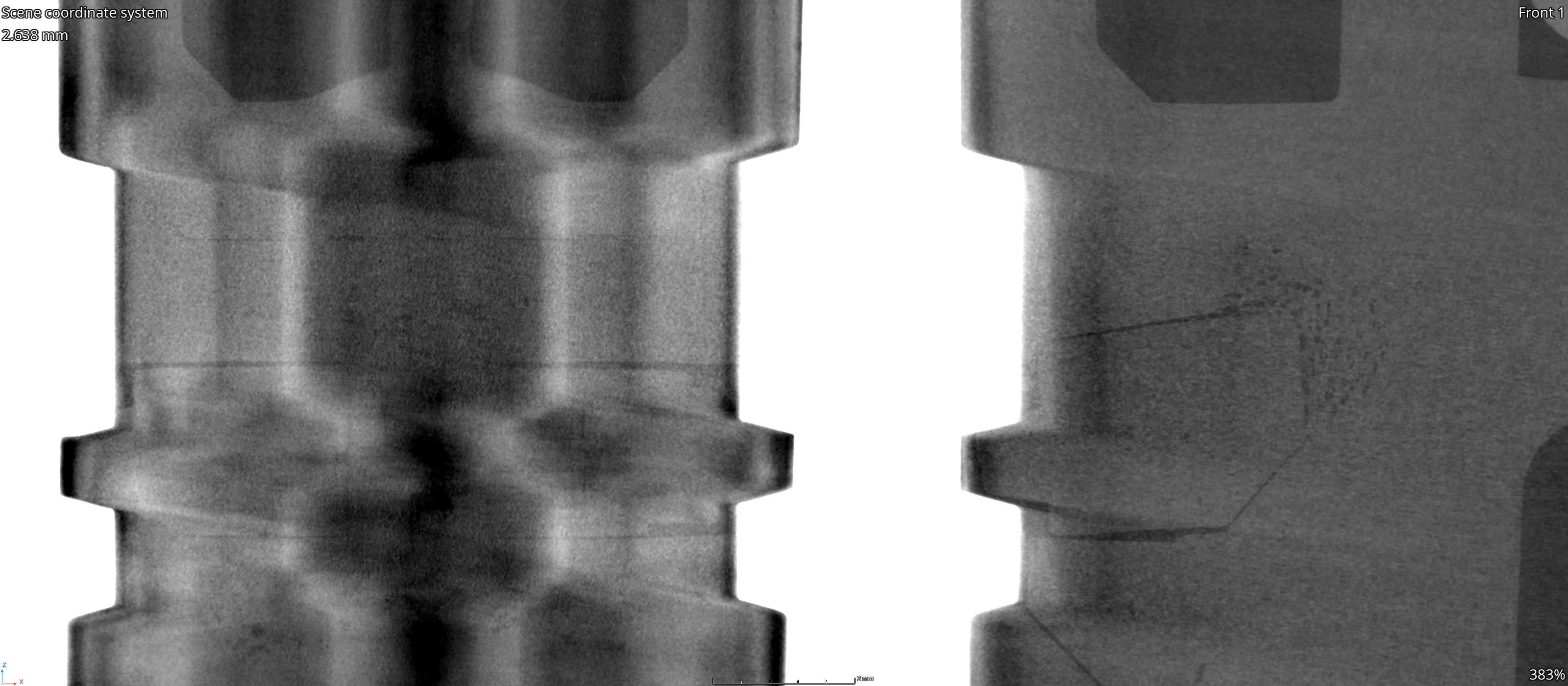
Standard FBP vs Voxray QRT
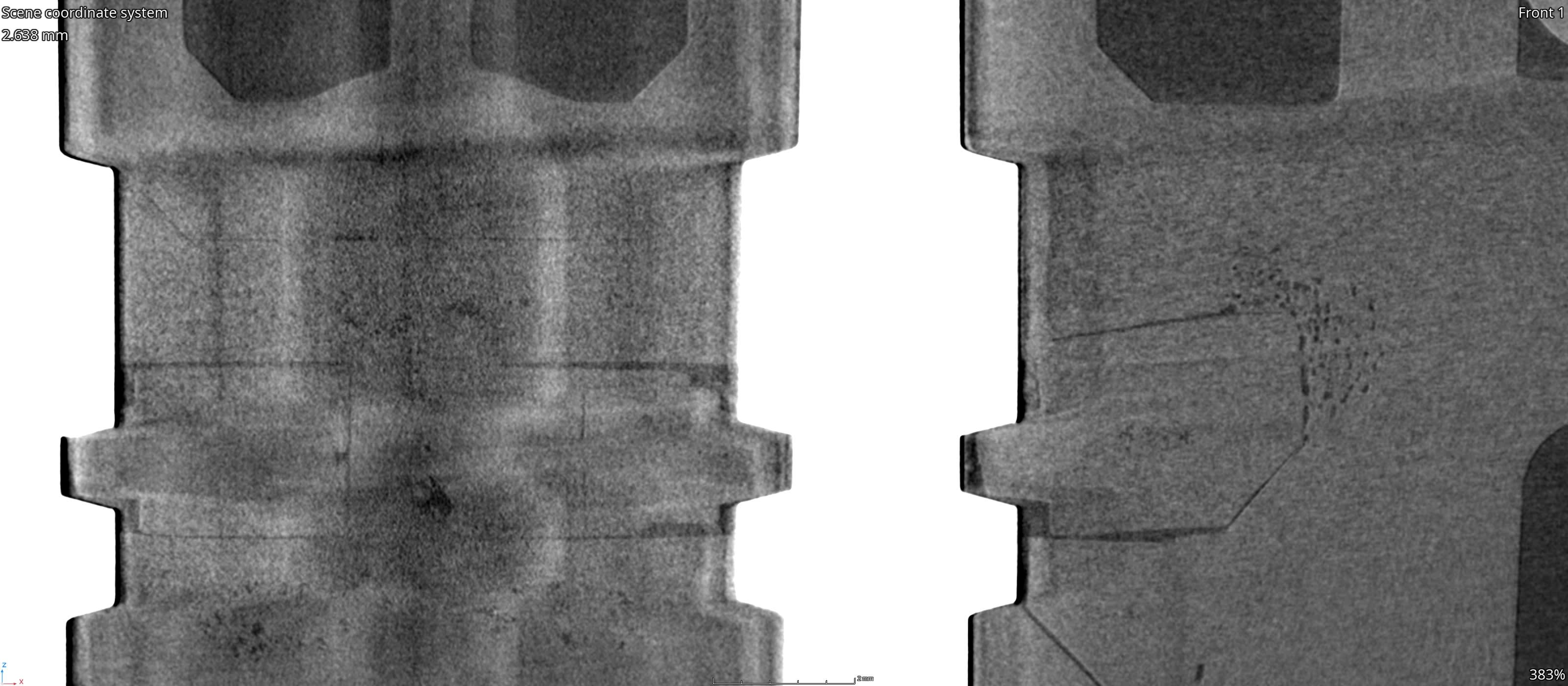
Dual‑Energy CT vs Voxray QRT
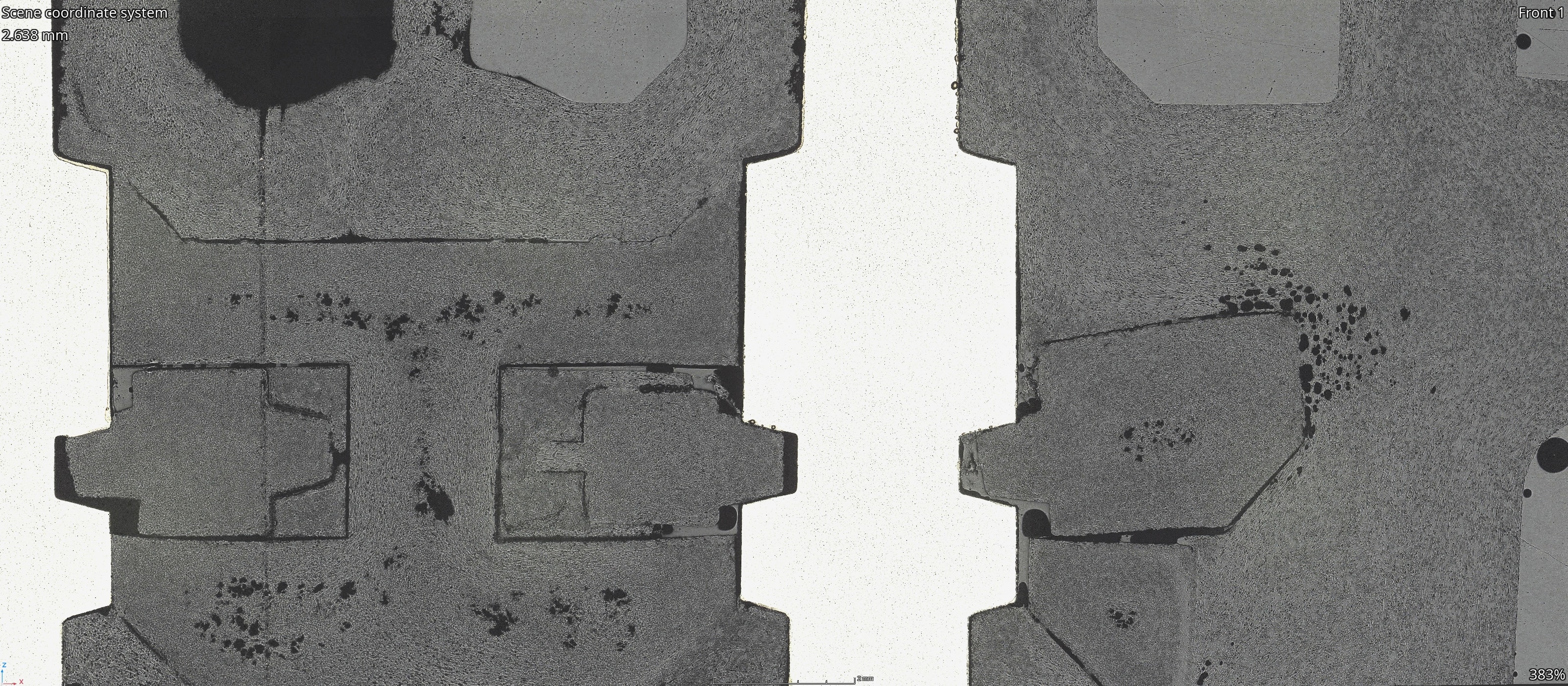
Voxray QRT vs micrograph of polished cross-section
Key Findings
- Voids between metal pins are completely hidden in FBP, partially visible in DE, and clearly resolved in QRT.
- Plastic particles are accurately represented only in QRT.
- Gaps show higher contrast in both DE and QRT when compared to FBP.
- Minor alignment artefacts are present in the DE volume because two separate energy datasets must be registered.
- Defects immediately adjacent to extremely dense regions remain problematic for all three methods.
Of the evaluated techniques, QRT delivers the most faithful reconstruction of voids, gaps, and polymer inclusions while requiring only a single scan. Compared with dual‑energy CT it therefore cuts measurement time in half and eliminates inter‑scan alignment errors – a decisive advantage for inline industrial defect detection.
The table below summarizes key metrics for each imaging and validation method:
Method | Measurement | NDT | Artefact | Precise |
|---|---|---|---|---|
| Polished section (PST) | > 4 h | ❌ | ✅ | ❌ |
| Filtered back projection (FBP) | 3 h | ✅ | ❌ | ✅ |
| Dual-energy fusion (DE) | 8 h | ✅ | ✅ | ❌ |
| Quantum reconstruction technique (QRT) | 3 h | ✅ | ✅ | ✅ |
In this article